
The reassuring answer is that these goals do not have to compete. With accurate margin assessment and thoughtful reconstruction, it is often possible to clear a facial skin cancer completely while preserving as much healthy tissue as possible. For many facial lesions, particularly basal cell carcinoma (the most common skin cancer in New Zealand), Mohs surgery is designed to do exactly that.
This guide explains why the face calls for extra precision, how margins are decided, the main reconstruction options, and what to expect from scarring.
Why Does Facial Skin Cancer Need a Precise Approach?
The face is crowded with structures that matter, both functionally and cosmetically. Eyelids, nostrils, lips and ears all sit within a few centimetres of each other, and the skin over the nose in particular is tight, with very little spare tissue to work with.
That creates two competing pressures for any surgeon:
- Remove too little tissue, and cancer cells may be left behind, which can lead to regrowth and a larger second operation.
- Remove too much, and the wound becomes bigger, the repair more complex and the scar more noticeable.
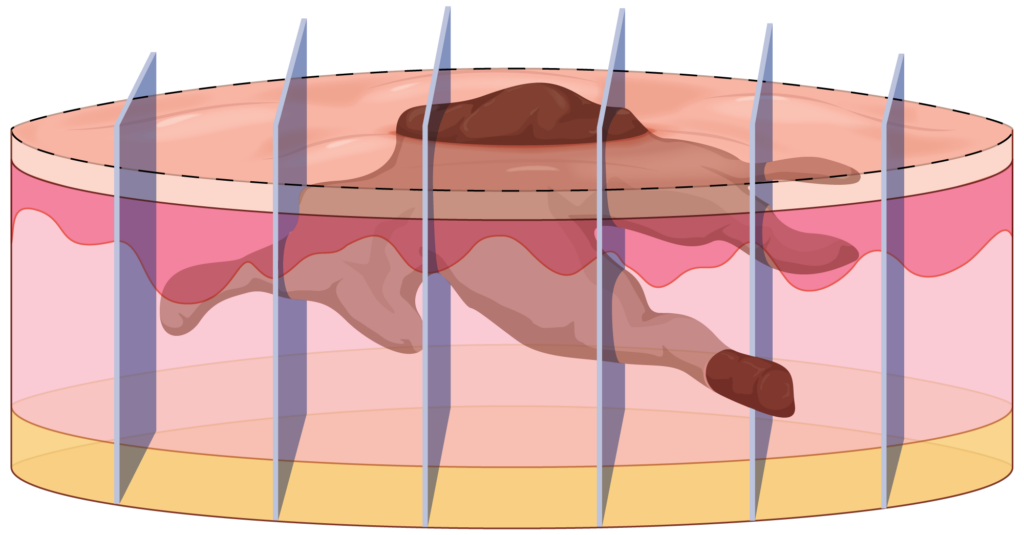
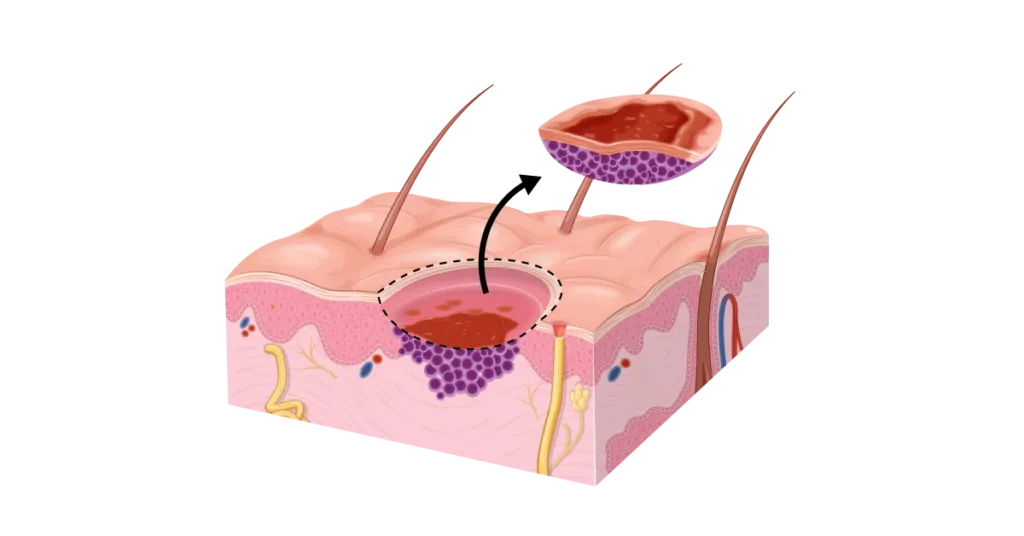
What makes this balance tricky is that a basal cell carcinoma does not always stop where it appears to. Some grow fine, root-like extensions beyond the visible edge of the skin, which cannot be seen with the naked eye. This is especially relevant on the face, where basal cell carcinomas most often develop on sun-exposed areas such as the nose, cheeks and forehead. On the back, a generous margin solves the problem easily. On the side of the nose, every extra millimeter counts.
How Are Surgical Margins Decided?
With a standard excision for facial skin cancer, the surgeon identifies the visible edge of the lesion, adds a safety margin of normal-looking skin, and removes it as an ellipse so the wound can be stitched in a straight line.
For a low-risk basal cell carcinoma, a margin of around 4 mm is widely used, a convention supported by a 2010 meta-analysis of surgical margins. Higher-risk basal cell carcinoma subtypes, or tumours with poorly defined borders, may need wider margins.
On the face, the arithmetic adds up quickly. A small lesion plus a margin on every side, converted into an ellipse for closure, can produce a wound and scar considerably longer than the original spot.
What does a “clear margin” on a pathology report actually mean?
After a standard excision, the tissue is sent to a laboratory, sliced at intervals a little like a loaf of bread, and a sample of those slices is examined under the microscope. A clear report means no tumour was seen in the sections reviewed. That is genuinely reassuring, but it is not the same as examining the entire edge of the specimen. You can read more about this on our page explaining incomplete excision.
How Does Mohs Surgery Balance Clearance and Appearance?
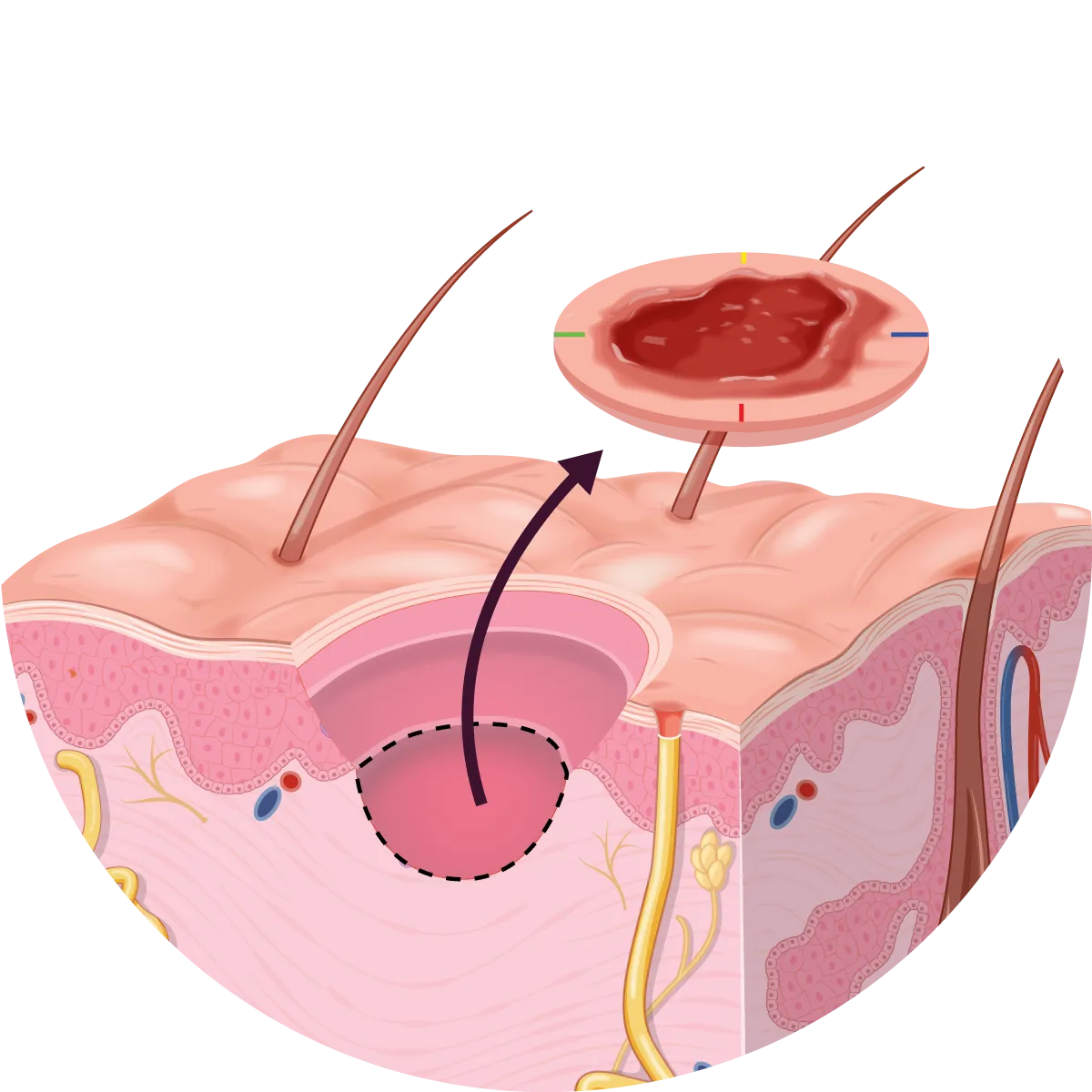
Rather than relying on a fixed, generous margin, Mohs surgery removes the facial skin cancer in thin, carefully mapped layers and checks each one on the same day. It is most often used for basal cell carcinoma (BCC) and squamous cell carcinoma (SCC) on the face. The process generally looks like this:
- The area is numbed with local anaesthetic and the visible tumour is removed with a narrow margin.
- The tissue is marked, colour-coded and mapped so its exact orientation is known.
- In the laboratory, the tissue is cut into thin sections and stained.
- The Mohs Surgeon examines the entire deep and peripheral margin under the microscope.
- If cancer cells remain, a further layer is taken only from that precise spot, and the process repeats until the margins are clear.
- The wound is then repaired, usually on the same day.
Because healthy skin is spared wherever possible, the final wound is often smaller than with a standard excision, leaving more options for a neat repair.
Is Mohs surgery right for every facial lesion?
Not always, and an honest assessment should say so. Depending on the type, size and location of the skin cancer, other treatments may sometimes be considered. Your surgeon will advise you which approach is most appropriate for you. Mohs takes longer, often several hours, and has a higher upfront cost. It tends to be recommended where tissue conservation is most valuable, such as the nose, eyelids, lips and ears, or where a tumour is recurrent, poorly defined or a more aggressive subtype. Our skin cancer removal page outlines the full range of options.
What Are the Reconstruction Options After Surgery on the Face?
Once the margins are clear, the focus turns to repair. The choice depends on the size and position of the wound, the looseness of the surrounding skin, and your own priorities.
- Healing by itself: some wounds, especially in concave areas like the inner corner of the eye can heal without stiches.
- Side-to-side closure: the edges are brought together in a straight line, ideally placed within natural creases so the scar blends in.
- Local flap: nearby skin is gently moved or rotated to cover the wound. This is common on the nose and cheek because the colour and texture match closely, and scar lines can often be hidden along natural boundaries.
- Skin graft: skin is taken from another area, such as in front of or behind the ear, and placed over the wound. Grafts can work well, though the colour and texture may differ slightly at first.
What Will the Scar Look Like?
Any facial skin cancer surgery leaves a scar, and it is important to be upfront about that. The encouraging part is that the face has an excellent blood supply and often heals well.
In the early weeks, a scar may look pink, firm or slightly raised. Over the following months it typically softens and fades, and it can continue to improve for a year or more. Factors that can influence the final result include:
- The location and size of the wound
- Your skin type and natural healing tendencies
- Smoking, which can slow healing
- Careful wound care and avoiding tension on the area
- Diligent sun protection while the scar matures
If a scar needs extra help later, laser resurfacing may be discussed. You can find more information about laser resurfacing here.
What About Cost and Insurance in Auckland?
Many New Zealand health insurers will consider funding surgery for a facial skin cancer, subject to your individual policy. Skintel is an Affiliated Provider for Southern Cross and NIB for contracted treatments where medical necessity criteria apply, which can simplify approvals. Some insurers require a referral, so check before your appointment. Our medical insurance page has more detail.
When Should a Spot on Your Face Be Checked?
It is sensible to have any spot assessed if it is new, changing, bleeding easily, or a sore that does not seem to heal. A dermatologist using dermoscopy can often reach a confident diagnosis without a biopsy, which helps avoid unnecessary procedures. If you have not had a full skin check in a while, it is a practical place to start.
The Takeaway
Treating a facial skin cancer is not a choice between clearing the cancer and protecting your appearance. With precise margin control, careful slide analysis and a repair planned around your face, both can usually be achieved together. Every case is different, so the best next step is a specialist assessment.
If you would like to understand your options, you can learn more about Mohs surgery and our other treatments or book a consultation with our dermatologist-led team in Auckland.
